


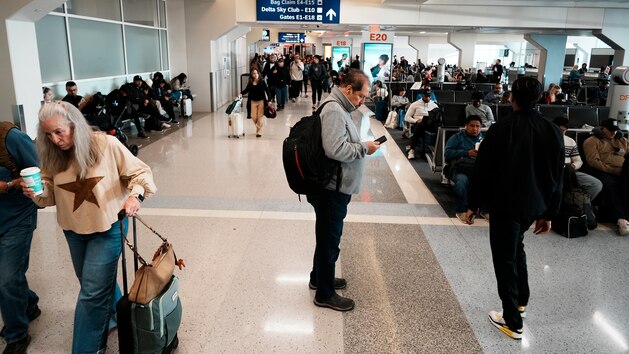
The nationwide ground stop last week thrust funding for the Federal Aviation Administration into the spotlight as Transportation Secretary Sean Duffy and President Donald Trump call for more money to fix a system they say is broken.
The number has ballooned over the course of a year, from the $12.5 billion that was appropriated by Congress to an additional $50 billion that Duffy asked for in the wake of the ground stop.
Their calls come as a lame-duck Congress looks to wrap up its work for the year.
Here's a look at where things stand:
What has Duffy said recently?
When the Department of Transportation announced its plan in 2025 to build a new air traffic control system, the agency said it would need $20 billion in addition to $12.5 billion appropriated last year by Congress under Trump's so-called "One Big Beautiful Bill" to complete air traffic control modernization efforts -- digitizing its communications and technological capabilities -- by 2028.
Despite that initial estimate, FAA Administrator Bryan Bedford testified in September 2026 that the agency would only need about an additional $10 billion to modernize the air traffic control system.
Still, later that month, Duffy increased his initial ask and requested $30 billion from Congress to complete the nationwide air traffic control overhaul. Duffy said at the time that the $12.5 billion was a down payment and additional funding was always needed to complete it.
On Friday, when the nationwide ground stop occurred, Duffy increased that prior funding request significantly, saying in a Friday night press conference that he is now asking Congress to give the DOT $50 billion.
"I did make a request for $30 billion. I've talked about $30 billion, and what I'm trying to do is get a number that I think the Congress will give me that gets a massive portion of the needs of the airspace completed," Duffy said in a Saturday press conference about the ground stop. "It's not a cheap proposition, and so let's make the investment and let's do it now. So I'm going to put in that full request. I'll detail it and send it over to the Hill in conjunction with the president."
Duffy has not released a breakdown of the costs for the $50 billion in funds he's now requesting, but only $10 billion of the DOT's previous $30 billion request was slated to "complete reliable digital architecture," according to a DOT press release.
Duffy's latest request was also for funds to create a more reliable digital architecture, overhaul outdated airport infrastructure, build world-class airports and to continue upgrades needed to build a brand-new air traffic control system.
The secretary's funding request garnered support from United Airlines CEO Scott Kirby who released a statement Sunday on the nationwide ground stop saying, "this moment must be a call to action."
"It is critical for safety, our passengers, and our economy that we fix our nation's Air Traffic Control system now. The FAA has incredible people who work hard, keep the skies safe, and take pride in what they do. They need to get to 100% staffing and to have the funds to modernize the technology. And they need and deserve 100% support from all of us," Kirby said in a post on LinkedIn.
Duffy's justification for his growing request was met with a mix of skepticism -- even by members of his own party.
"Well, of course they should use that money," Sen. John Hoeven, R-South Dakota, told reporters on Capitol Hill. "What Secretary Duffy said that you've probably seen is he's saying, 'well, that's for certain technology,' but then there's other -- some of the communications technology that they need to upgrade too -- wasn't included in that $12.5 because that $12.5 was laid out for certain things, which it should be."
Hoeven emphasized that he has a seat on the Senate Appropriations Committee.
"We have to have accountability too," he said.
What money did the FAA get from the One Big Beautiful Bill?
Duffy will come to Congress hat in hand on Tuesday when he joins Senate Republicans for lunch in the Capitol. But the group of Republicans he'll be addressing is the same group that already gave the FAA a sizable amount of money for air traffic control last year.
Republicans allocated $12.5 billion for air traffic control as part of the so-called "One Big Beautiful Bill" -- later rebranded as the Working Families Tax Cuts Act, which passed out of Congress with almost exclusively Republican support in July 2025. Within that pot is $4.75 billion specifically allocated for "telecommunications infrastructure modernization and systems upgrades."
Duffy spoke with top House leaders on Monday, multiple sources told ABC News.
The secretary talked by phone with House Minority Leader Hakeem Jeffries, according to a person familiar with the conversation. Duffy also spoke by phone with House Speaker Mike Johnson, according to a source familiar with the conversation.
Johnson said over the weekend that Congress would consider Duffy’s call for up to $50 billion to modernize air traffic control and airport infrastructure. The speaker’s office did not immediately respond to ABC News’ request for comment on how Congress would address the funding during the lame-duck session.
Friday's ground stop happened because of a telecommunications issue, both Duffy and Homeland Security Secretary Markwayne Mullin said.
According to a breakdown of spending recently released by DOT, much of that $12.5 billion remains unspent. The money that has been spent has been used on things such as making foundational upgrades, copper fiber replacement and radar and surveillance, according to DOT.
On Sunday, Duffy argued that the full amount Republicans gave to DOT through the One Big Beautiful Bill has not been spent because Congress has restricted how the department could spend it. The agency contends that the legislation does not give them "the legal flexibility" to use the money beyond parameters set by Congress.
"Congress placed parameters on the [OBBB] funding outlining exactly how much of the total package could be spent on specific categories of work. The Department does not have the legal flexibility to move funds from one workstream to another," DOT says.
"They gave me money for tower, for radios, money for radar, money for systems. But I don't have any money in that $12.5 billion for a new architecture for telecom. I don't have any money given by Congress to build a new software system to manage the airspace. They're very specific on how we spend the $12.5 [billion], and none of the money goes to this telecom that I have to build," Duffy said on CBS' "Face the Nation." "We're building at an amazing speed that's happening safely, but $12.5 billion is not nearly enough to fix a system that has been neglected for decades."
The bill passed through both chambers of Congress in July 2025 and was signed by Trump -- something the GOP achieved almost entirely without Democratic buy-in.
Senate Majority Leader John Thune on Monday rebuffed Duffy's assertion that Congress didn't properly allocate money to fund upgrades, pointing out that some of the funding hasn't yet been spent.
"There's some explanations that have to be given as to why that number is where it is. But I think we have attempted to do what we can to ensure that the concerns they have about modernization are being met," Thune said.
What other funds for the FAA has Congress appropriated?
The One Big Beautiful Bill is not the only source of funding for the FAA that Congress has approved in the last several years.
President Joe Biden signed the FAA Reauthorization Act in 2024 -- a four-year, $105.5 billion bill. A provision in the package called for technology partnerships with stakeholders that identified software, systems, services and technologies that could improve aviation safety and the operations and management of the air traffic control system.
Congress also passed the Infrastructure Investment and Jobs Act under Biden in 2021. That bill allocated $25 billion for the FAA. Though $5 billion of that was specifically for air traffic control, much of it was to update towers at airports and other FAA facilities.
Democrats contend that the Trump administration has blocked or stalled billions in funding that passed in the bipartisan infrastructure bill since taking office.
"Instead of laying out the facts, Secretary Duffy commanded the public's attention to demand a $50 billion ransom without a real plan to deliver," Rep. Rosa DeLauro, the incoming chair of the House Appropriations Committee noted Sunday. "Secretary Duffy and the Federal Aviation Administration have received historical and monumental investments over the last two years, over $12.5 billion of which was provided without meaningful guardrails or accountability requirements and largely remains unspent. No federal leader should be free to do their work without Congressional oversight. Congress has shown its willingness to modernize the FAA's systems and support its workforce as part of annual bipartisan legislation, but we need a competent partner at the Department of Transportation to carry this out in a sustainable, transparent manner. Right now, it is clear that we lack such a partner."
Did the White House request as much as Duffy says he needs?
The short answer: no.
In Trump's FY2027 budget request sent to Congress last spring, the administration requested $481 million more than the previous year for FAA operations and capital. But that budget request encompassed a number of FAA-related priorities -- not just funding to upgrade the air traffic control systems.
That same budget also included a $4 billion request for "facilities and equipment" -- explaining that when "paired with the $12.5 billion" in the One Big Beautiful Bill, the latest request for an influx of money "would allow the FAA to continue to build a Brand New Air Traffic Control System."
White House budgets are generally viewed as a wish list presented by the administration ahead of the congressional budget and appropriations seasons. Though the 2027 fiscal year began in October, Congress has not yet passed any funding bills into law. The government is currently operating on a short-term extension of fiscal year 2026's appropriations levels.
What could Congress do now?
Congress, meanwhile, is working with limited time and limited ability to approve additional funding for the agency -- given that the 119th session will end on Jan. 3.
The government is set to run out of funding on Dec. 12 -- and while lawmakers could include additional funding for the FAA in a short-term funding bill or try to pass a stand-alone funding bill for the FAA. Negotiations over funding this close to a new Congress convening could create massive headaches and risk government shutdowns.z
With Democrats growing increasingly frustrated with a lack of clarity around Duffy's funding requests, Speaker Mike Johnson said over the weekend that Congress would take up the administration's verbalized request for up to $50 billion to modernize air traffic control and airport infrastructure. ABC News has asked the speaker's office for clarification on how Congress would address the funding.
"We're working on an aggressive legislative package to finish out the year strong, run through the tape ... and this will be added to that," Johnson said on Fox News on Saturday. "We don't really need any investigation to understand we need further investmen. ... some of this equipment dates back to the '80s, so it's got to be updated, and that's our responsibility. We're going to work to get it done."
Staff members from the DOT will provide a virtual briefing to staff members of the House Transportation and Infrastructure Committee on Tuesday.
Copyright © 2026, ABC Audio. All rights reserved.


