


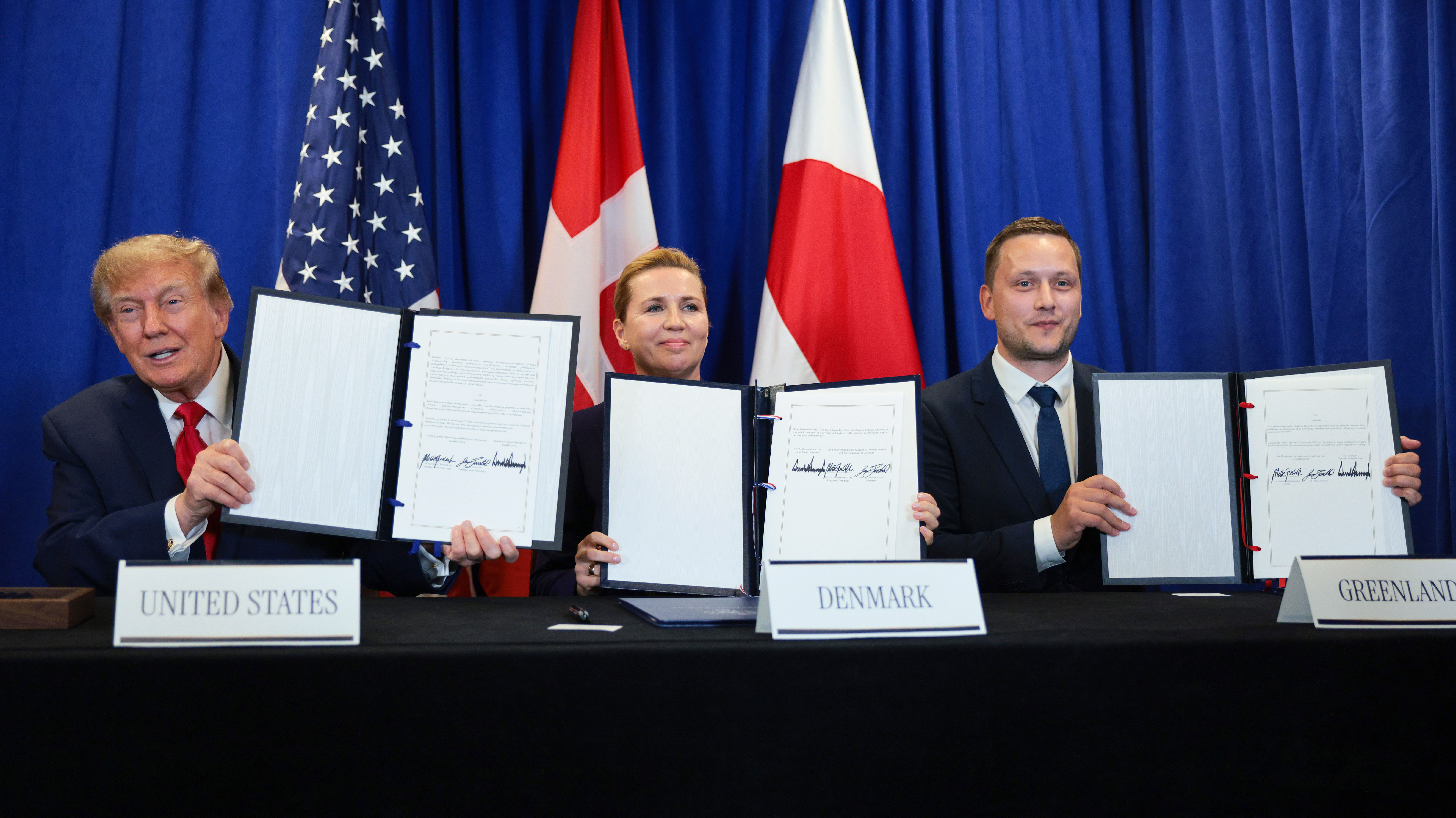
(WASHINGTON) -- President Donald Trump signed a security deal with the prime ministers of Greenland and Denmark on Tuesday on the sidelines of the United Nations General Assembly.
"This has been an amazing journey with tremendous people," Trump said of Denmark's Mette Frederikson and Greenland's Jens-Frederik Nielsen.
"This is tremendous for Europe and for the United States, for everybody, and for Greenland," Trump said. "It's going to be incredible, and the people of Greenland have been so nice. The people of Denmark have been amazing, and so I know it's going to be a long-term, fantastic relationship."
The agreement comes after months of escalating rhetoric from Trump, who has repeatedly threatened to take over the territory citing national security purposes. Trump's threats, including refusing to rule out taking the territory by military force, sowed tension between the U.S. and its European allies and sparked consternation from Greenlanders.
Greenland, which is an autonomous territory of Denmark, resisted Trump's calls to "take over" the island via acquisition or military force. Danish leaders said they were open to negotiating new frameworks for the U.S. military's presence, but that the sovereignty of the territory was a red line.
The text of the trilateral agreement reveals some red tape that constrains what Trump administration officials have billed as the "complete ability" to do what it deems necessary in Greenland.
While the deal appears to fall short of the "Complete and Total Control" by the U.S. that Trump once called for, it does grant the U.S. ability to expand its military footprint in Greenland.
The deal gives Greenland and Denmark the authority to review requests from the U.S. to build unmanned military installations "under accelerated governmental approval procedures."
Frederikson praised the agreement, saying that it was "bigger and better" than the deal struck with the U.S. in 1951.
"Seventy-five years ago, we entered into an agreement about the defense of Greenland. Today we are signing an even bigger and better agreement, a deal that can last forever," she said.
"Mr. President, you have been very clear. You don't want adversaries to come too close. I fully agree, and with this deal, they are not," she added.
Under the 1951 agreement amended by the new pact, the U.S. already enjoyed wide latitude to scale up its bases and military footprint on the island.
Nielsen acknowledged that the U.S. national security concerns are legitimate and praised the negotiation process that led to the agreement.
"The security landscape in the Arctic is changing, and we recognize the long term security threats that you, Mr. President, have rightly spoken about. It is for that very reason that we have insisted on engaging in a constructive dialog," he said. "Your security is our security, and our security is your security."
Nielsen called the agreement historic and a "win-win-win" for all parties.
NATO Secretary General Mark Rutte posted on X, "This agreement, along with NATO's growing role in securing this vital region, enhances our collective security and supports a safer and more stable future for us all."
In a post on his social media platform last Friday, Trump declared, "At my direction, we worked with representatives of Denmark and Greenland to guarantee that the United States will FOREVER have the complete ability to do what is necessary in Greenland in order to secure and defend the security of Greenland, and the United States of America."
The text of the deal affirms released Tuesday states that the U.S. can "modernize and expand its activities" at its existing Pituffik Space Base and says it can establish additional bases at Narsarsuaq and Mestersvig, following specific terms that the signatories had already agreed to.
If the U.S. wants to expand its footprint beyond that, the agreement requires that it puts forward a proposal that all parties will "immediately convene" to review via a standing committee that was established by an earlier memorandum of understanding.
If no agreement is reached within 90 days, the deal specifies that the proposal will then be elevated to the deputy minister level, and if that fails to the minister level -- secretary of state and equivalents. The text does not say what would happen if those consultations don't end in a consensus.
The deal gives Greenland and Denmark the authority to review requests from the U.S. to build unmanned military installations "under accelerated governmental approval procedures."
While the agreement details the U.S. military's right of free access to land, air and sea routes, it does not appear to materially advance privileges granted by the 1951 defense pact.
The agreement also bars non-NATO from establishing military installations in Greenland unless the three parties agree to make an exception.
The agreement also bans countries and individuals from countries that are either not NATO members or partners nor members of the European Union from having control or significant influence over "Particularly Sensitive Sectors" that includes critical infrastructure and the extraction of resources. The deal puts Greenland in charge of ensuring these prohibitions are upheld under its current or future investment screening laws.
The agreement specifies it has no end date and it plans for a contingency in which Greenland declares its independence from Denmark. An independent Greenland will agree to remain a member of NATO, athough that decision would likely not be entirely up to Greenland, the U.S. or Denmark -- joining the alliance requires the approval of all NATO members and an independent Greenland would have to go through the application process.
Copyright © 2026, ABC Audio. All rights reserved.

.jpg)

