


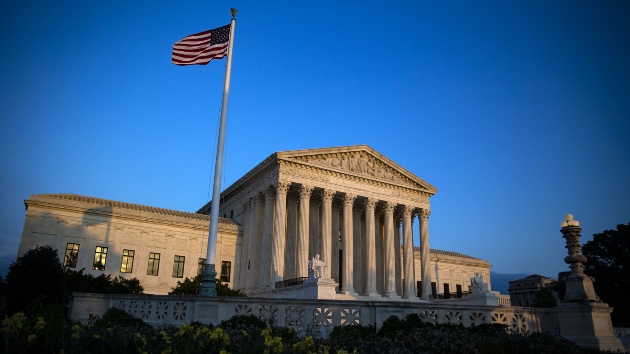
(WASHINGTON) -- In a landmark decision that could transform the federal government, the Supreme Court has voted to allow President Donald Trump to remove a Democratic member of the Federal Trade Commission, Rebecca Slaughter, for policy reasons, rolling back 90 years of legal precedent that had prevented at-will removal of independent agency officials and significantly expanding presidential power.
The 6-3 decision came from Chief Justice John Roberts.
Writing for the majority, Roberts declared "for cause" removal protections imposed by Congress at more than two dozen independent, bipartisan government agencies a violation of the separation of powers.
"What text, history, and structure settle, our precedent confirms -- the President may remove his subordinates at will," Roberts wrote.
The decision gives Trump and future presidents more control over the government and effectively ends the bipartisan, independent nature of regulatory agencies that oversee many aspects of American life.
President Trump, in a post to his social media platform, called the Supreme Court's decision a "BIG WIN" and "one of the most important ever given with respect to Presidential Powers."
In her dissent, Justice Sonia Sotomayor, joined by Justices Elena Kagan and Ketanji Brown Jackson, accused her colleagues of endorsing a theory of "total executive control" unimagined by the nation's founders.
"The result is a President who emerges with far greater power than ever before," Sotomayor wrote. "It is a power, however, that neither the People, nor Congress, nor the Constitution bestowed upon him. In granting the President this unbridled authority, the Court upends its precedent, misconstrues our history, and sheds any pretense of judicial modesty. I respectfully dissent."
Since the New Deal era, independent agencies -- historically led by subject-matter experts from both parties -- have policed stock trades, transportation systems, election campaigns, consumer product safety and broadcast licenses.
Giving the president more direct control over who serves on those bodies has long been a goal of conservatives, who have objected to unelected bureaucrats wielding too much power with little accountability.
The ruling is a loss for liberals who have long championed a role for agencies like the FTC, Federal Election Commission, Securities and Exchange Commission, Federal Communications Commission and dozens of others insulated from politics in the interest of the regulatory consistency.
The court's decision does not eliminate the agencies themselves but will allow them to be packed with only Republicans or only Democrats, if a president wishes, giving the White House more direct control over their functions.
The conservative majority effectively overruled a unanimous 1935 Supreme Court decision involving the FTC -- Humphrey's Executor v. U.S. -- which had previously affirmed limits on a president's ability to fire members of the commission only for cause.
"Humphrey’s Executor is just a dried husk of whatever people used to think it was," Chief Justice John Roberts said bluntly during oral arguments in December.
Copyright © 2026, ABC Audio. All rights reserved.


.jpg)

